How to Choose an Apartment in Copou, Iași — Complete Guide 2026
Essential criteria for selecting the perfect apartment: size, floor, orientation, building materials, parking, and the advantages of new construction.
Read article →Useful information about the real estate market, construction quality and life at Royal Town Copou
A detailed analysis of the Copou area: from its academic heritage and green spaces, to price growth of over 100% since 2017 and expanding infrastructure. Discover why investors choose Copou.
Read article →
Essential criteria for selecting the perfect apartment: size, floor, orientation, building materials, parking, and the advantages of new construction.
Read article →
Discover how buying directly from the developer eliminates agency fees and what other benefits you get: transparency, customization, warranty.
Read article →
An analysis of price evolution in the Royal Town complex — from the first phase in 2017 to current prices. Over 100% appreciation in just 8 years, a record for the Iași market.
Read article →
A detailed description of materials and finish brands: Ariston boilers, Villeroy & Boch sanitary ware, Grohe faucets, Rehau underfloor heating, herringbone parquet, marble-effect entrance halls.
Read article →
An in-depth analysis of structural quality: C25/30 reinforced concrete, 25 cm Porotherm walls, 10 cm basalt wool insulation, Schindler elevators, and top-tier seismic resistance.
Read article →
Morning coffee with a panoramic view, a supermarket on the ground floor, a children's playground, gym, pharmacy — everything within the complex. Over 1,400 apartments form a true community.
Read article →
A complete comparison of buying old vs. new apartments: energy efficiency, maintenance costs, depreciation, rental yield (15-20% annually in EUR), and resale value.
Read article →
Everything you need to know about the Copou area: universities, the Botanical Garden, Copou Park, infrastructure, public transport, schools, supermarkets and restaurants.
Read article →Copou is not just a neighborhood in Iași — it is a symbol of Moldavian culture and education. It is home to "Alexandru Ioan Cuza" University, the oldest university in Romania, founded in 1860. On Copou Hill, Mihai Eminescu wrote some of his masterpieces under the linden tree that bears his name. The Botanical Garden, one of the largest in Southeastern Europe, showcases over 10,000 plant species across 100 hectares.
This cultural heritage has turned Copou into one of the most sought-after residential areas in Iași. Its proximity to university centers, major hospitals and the historic city center makes Copou a strategic location for both permanent residents and real estate investors looking to buy apartment in Romania.
The Copou real estate market has experienced steady growth in recent years, significantly outpacing the city-wide average in Iași. In 2017, the average price per square meter for a new apartment in Copou was approximately 850-900 EUR. By 2026, prices have reached 1,700-2,000 EUR per square meter for quality developments, representing an appreciation of over 100% in less than a decade.
This growth is not coincidental. Demand for housing in Copou is driven by multiple factors: students, university faculty, doctors from nearby hospitals, IT professionals seeking a premium lifestyle, and investors looking for solid rental yields. The combination of these demand drivers makes new apartments in Iași, especially in the Copou district, a compelling investment opportunity.
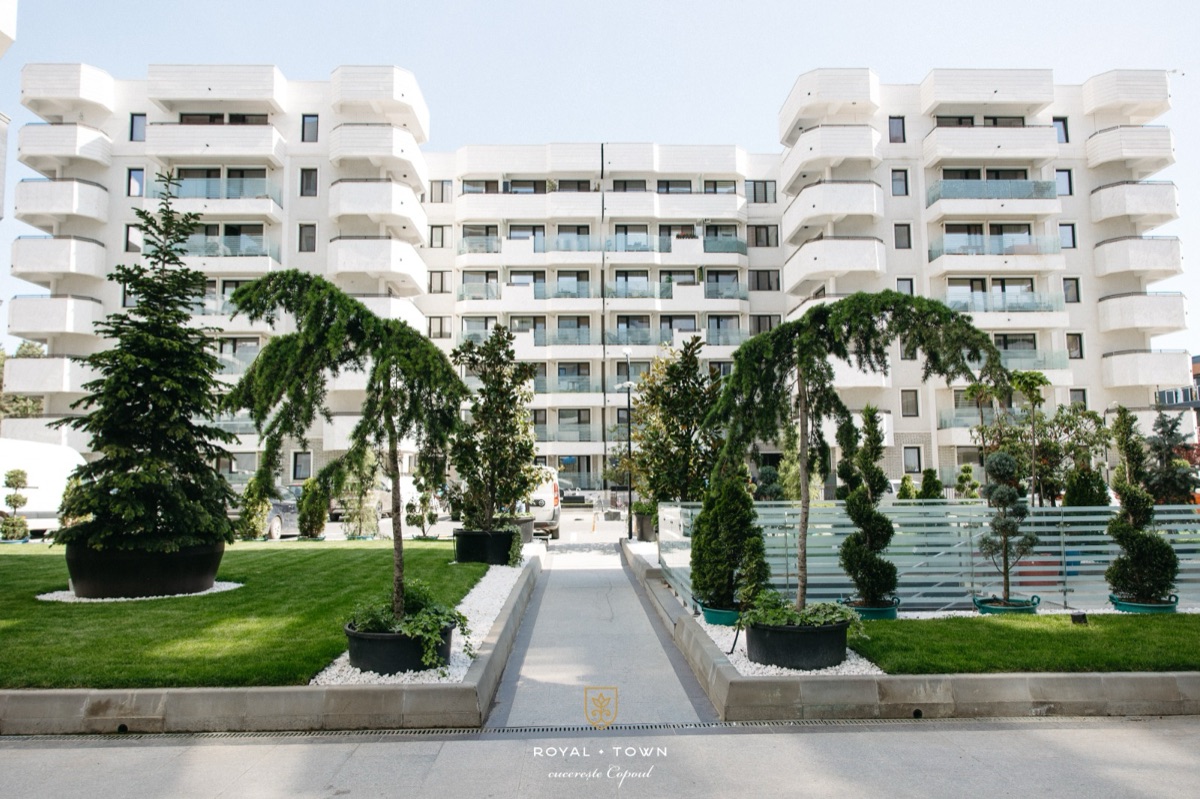
Located on Aleea Mihail Sadoveanu, Royal Town is the largest residential complex in Copou, comprising 11 buildings and over 1,400 apartments with 1, 2 and 3 bedrooms. The complex offers a full range of amenities: supermarket, pharmacy, dental clinic, beauty salon, fitness center, children's playground, underground and above-ground parking.
What sets Royal Town apart from other developments in Iași is the level of finishes included in the price. Every apartment is delivered turnkey with: Ariston central heating, Villeroy & Boch sanitary ware, Grohe faucets and accessories, Rehau underfloor heating, herringbone parquet flooring, marble-effect ceramic entrance halls and superior quality interior doors. For anyone searching for apartments Iasi Romania with premium specifications, Royal Town Copou sets the standard.
Key takeaway: Unlike most new developments in Iași, Royal Town apartments are delivered fully finished and turnkey. Buyers do not need to invest an additional 15,000-25,000 EUR in fit-out — a significant saving in both time and money.
The Copou area benefits from a well-developed transport network. Trams and buses connect the neighborhood to the city center in approximately 10 minutes. The drive to Palas Mall, the commercial and business hub of Iași, takes under 15 minutes by car. Iași International Airport is accessible in 20 minutes.
In the immediate vicinity of Royal Town you will find: "Alexandru Ioan Cuza" University, "Grigore T. Popa" University of Medicine and Pharmacy, the Rehabilitation Hospital, the Botanical Garden, Copou Park and multiple shopping centers. Aleea Sadoveanu, where the complex is located, has been recently modernized with wide sidewalks, cycling lanes and LED street lighting.
When analyzing the main residential areas in Iași, Copou stands out through several unique advantages. Unlike Păcurari or Galata, where development has been chaotic and lacking in amenities, Copou offers mature infrastructure, generous green spaces and a stable socio-demographic profile. Compared to CUG or Bucium, where prices are lower but accessibility is limited, Copou combines competitive pricing with a central location — an ideal balance for Copou real estate investment.
The Copou area has consistently maintained the highest rental prices in Iași, with gross annual yields of 5-7% for 1- and 2-bedroom apartments. For investors who purchase in EUR and collect rent in EUR, the net return can reach 15-20% annually when capital appreciation is factored in.
Real estate market analysts in Romania forecast a continuation of the upward trend in Iași, particularly in premium areas such as Copou. The factors supporting this outlook include: rising salaries in the IT sector (Iași is Romania's second-largest IT hub after Bucharest), transport infrastructure development, government programs supporting home purchases, and a persistent shortage of quality new housing.
Royal Town Copou is in its final phase of development, and the remaining available apartments represent an opportunity for investors who want to benefit from future price appreciation. The complex has already demonstrated an excellent resale rate, with many owners from the early phases achieving significant profits upon sale.
Conclusion: Copou remains the area with the highest appreciation potential in Iași. The unique combination of academic prestige, green spaces, modern infrastructure and quality residential projects like Royal Town makes this area the ideal choice for both living and long-term real estate investment in Romania.
Iași is no longer just the cultural capital of Moldova — over the past 10 years, the city has transformed into one of the most dynamic economic centres in Romania. The IT sector has grown exponentially, with over 15,000 specialists working for companies such as Amazon, Continental, Endava and Centric. The average net IT salary exceeds 8,000 lei in 2026, nearly double the city average.
This economic growth has generated constant housing demand, especially in premium areas. Copou, with its academic tradition and mature infrastructure, has been the primary beneficiary of this trend.
An analysis of price per square metre in the Royal Town complex reveals a remarkable trajectory:
• 2017 (Phase 1): 750–850 EUR/sqm — launch price for the first buildings
• 2019 (Phase 3): 950–1,050 EUR/sqm — ~25% increase from launch
• 2021 (Phase 5-6): 1,100–1,250 EUR/sqm — post-pandemic demand accelerates the market
• 2023 (Phase 8-9): 1,350–1,500 EUR/sqm — inflation and construction costs push prices higher
• 2026 (Final phases): 1,900–2,500 EUR/sqm — total appreciation of over 100%
For a 2-bedroom apartment (65 sqm total usable), the difference is enormous: from ~75,000 EUR in 2017 to ~150,000 EUR in 2026. Owners from the first phases who purchased for rental have recovered their investment through rents and, simultaneously, benefited from the doubling of property value.
Three factors differentiate Copou from the rest of Iași:
1. Stable and diversified demand. Copou simultaneously attracts students, academics, doctors, IT professionals and retirees seeking peace and greenery. This diversity protects the area from fluctuations in any single demographic.
2. Limited land supply. Unlike CUG or Bucium, where available land is still abundant, building in Copou cannot continue indefinitely. Royal Town occupies one of the last large plots in the area, creating natural price pressure.
3. Already-existing infrastructure. The Copou buyer isn't "hoping" the area will develop — it's already developed. Universities, hospitals, parks, public transport, supermarkets — everything exists and functions.
Anyone purchasing a Royal Town apartment in 2026 is buying at the peak of quality, but not at the peak of the market. Iași remains undervalued compared to Cluj-Napoca (where prices exceed 2,500 EUR/sqm) or Timișoara. As the local economy grows, Copou prices will continue to climb.
Conclusion: Royal Town Copou isn't just a residential complex — it's a case study in how location quality, construction quality and amenities create long-term value. The data is clear: investing in Copou was, is and will remain one of the safest bets in the Iași real estate market.
When you visit an apartment, you see the finishes — the flooring, the bathroom, the kitchen. But what truly determines the lifespan, seismic safety and thermal comfort of a home is the structure you don't see: the concrete, walls, insulation and hidden installations. At Royal Town, the structure is designed for 100 years of use, in accordance with current European standards.
The entire load-bearing structure of Royal Town buildings is made from C25/30 class reinforced concrete — the most widely used concrete for quality residential construction in Europe. C25/30 means the concrete withstands a minimum compressive strength of 25 N/mm² on cylinder and 30 N/mm² on cube. BST500 steel rebar completes the structure, providing tensile strength and seismic flexibility.
Foundations are raft-type — a continuous concrete slab that evenly distributes the building's weight on the soil. This solution is superior to isolated pad foundations and provides maximum protection against differential settlement.
Exterior walls are built from Porotherm ceramic bricks with 25 cm thickness. Porotherm is the European leader in ceramic construction materials, and their bricks have an internal micro-cavity structure that provides:
• Natural thermal insulation — the thermal resistance of a 25 cm Porotherm wall equals a 2-metre thick concrete wall
• Sound insulation — over 47 dB sound attenuation, sufficient to block traffic and neighbour noise
• Humidity regulation — ceramic brick "breathes", absorbing and releasing moisture, maintaining a healthy indoor microclimate
• Fire resistance — class A1, completely non-combustible material
Over the Porotherm wall, Royal Town buildings are insulated with 10 cm basalt wool. Basalt wool is superior to polystyrene (EPS) in several ways:
• Doesn't burn (withstands over 1,000°C vs. polystyrene which melts at 240°C)
• Doesn't release toxic substances in case of fire
• Allows the wall to breathe, preventing condensation and mould
• Superior durability (doesn't degrade over time, unlike EPS)
• Thermal conductivity coefficient λ = 0.035 W/(m·K)
The Porotherm 25 cm + 10 cm basalt wool combination ensures an exterior wall thermal coefficient below 0.25 W/(m²·K), significantly below the limit imposed by the C107 standard for the Iași climate zone.
Each building is equipped with Schindler lifts — the Swiss manufacturer with over 150 years of experience. The lifts are quiet, sound-insulated, energy efficient (class A) and designed for a lifecycle of over 25 years. Capacity is 7 persons / 570 kg, with stainless steel doors and mirrored interior.
Installations are built with industrial-grade materials: PPR pipes for water, PVC tubes for drainage, oversized electrical cables for maximum safety. Electrical panels come fully equipped with differential automatic circuit breakers, protecting against short circuits and electrocution.
Romania lies in an active seismic zone, and Iași has a seismic intensity rating of VII on the MSK scale. Royal Town structures are designed according to the P100-1/2013 standard (updated), with a safety coefficient that exceeds minimum requirements. The C25/30 concrete, densified reinforcement at joints and raft foundation ensure elastic behaviour during earthquakes, protecting both the structure and residents' lives.
Practical tips for anyone evaluating an apartment:
• Ask the developer about the concrete class (C25/30 is standard, below C20/25 is concerning)
• Check the insulation type (basalt wool > polystyrene > no insulation)
• Request the building's energy certificate (Royal Town: class A or B)
• Check the lift brand (Schindler, KONE, Otis = reliable)
• Inspect hallways and basement — common area finish quality reflects overall quality
Conclusion: Royal Town's structure isn't visible, but it's felt: in lower heating bills, in apartment quietness, in seismic safety, and in resale value that grows year after year. It's the difference between a building that looks good for 5 years and one that performs flawlessly for 50.
With over 1,400 apartments in 11 buildings and over 2,500 residents, Royal Town isn't just a residential complex — it's the largest micro-city in the Copou area of Iași. Size matters: the critical mass of residents has attracted services that no isolated building can sustain. The result is a place where you live, work, shop and relax without depending on a car.
Within the complex operates a complete ecosystem of daily services:
• Supermarket — groceries, cleaning supplies, essentials, no trip to the hypermarket needed
• Pharmacy — medicines, vitamins, hygiene products, with extended hours
• Dental clinic — consultations and treatments without travelling into the city
• Beauty salons — hairdresser, manicure, cosmetics, massage
• Fitness centres — modern equipment, easy access for residents
• Easybox — parcel collection directly from the courtyard
These services weren't artificially planned — they appeared organically, attracted by the volume of residents. It's an indicator of the complex's economic viability.
Royal Town is located on Aleea Mihail Sadoveanu, in the heart of Copou's green zone. A 5-minute walk opens up the Botanical Garden — 100 hectares of nature, one of the largest in Europe. Copou Park, with its century-old alleys, is 8 minutes away. Aleea Sadoveanu, recently modernised, offers wide pavements and cycle paths for walks and jogging.
Inside the complex, children have access to playgrounds in the inner courtyard, away from road traffic. Landscaped green areas between buildings complement the outdoor space offering.
Despite being a quiet residential neighbourhood, Copou is not isolated. The bus stop is 1 minute's walk away, with direct connection to central Iași. By car, the centre is 10 minutes, Palas Mall 15, and the international airport 20. Underground and surface parking eliminate the stress of finding a parking space — one of the biggest problems of urban life in Iași.
For those working from home, fibre-optic connection (1 Gbps) is available from multiple providers. Apartments with 2.75 m ceiling height and open-plan living offer enough space for a comfortable work corner.
The complex benefits from 24/7 video surveillance, full exterior lighting and controlled access through automatic gates and barriers. Live cameras can be viewed anytime at royaltown.ro/live/ — a level of transparency unique in the Iași market.
Internal car traffic is limited to residents, and pedestrian areas within the complex are car-free. This is a fundamental difference from blocks on main roads, where noise and pollution are part of daily life.
Resident diversity is an asset: young IT professionals, families with children, academics, retired couples, students. Everyone finds their own rhythm here. Parent groups, informal neighbourhood events, acquaintances at the supermarket — a real community forms naturally, not just an address.
The socio-economic profile of residents is above the Iași average, contributing to a civilised environment with respect for quietness, cleanliness and shared spaces.
Conclusion: Life at Royal Town isn't just about an apartment — it's about a complete ecosystem that makes days simpler, safer and more pleasant. It's the difference between "living somewhere" and "living well at home".
Every real estate buyer in Iași faces the same question: is it worth paying more for a new apartment, or should I choose an older one at a lower price? The answer depends on the objective — but if we look at long-term investment, the data is clear.
The purchase price of an old apartment is deceptively low. An apartment from the '80s in Copou or Păcurari costs ~70,000 EUR, but requires:
• Complete replacement of electrical and plumbing installations (3,000–5,000 EUR)
• New PVC joinery (2,000–3,000 EUR)
• New flooring (1,500–2,500 EUR)
• Complete bathroom (3,000–6,000 EUR)
• Heating boiler (2,500–4,000 EUR)
• Labour + contingency (3,000–5,000 EUR)
Total: 15,000–25,000 EUR on top of the purchase price. The real difference compared to a Royal Town apartment shrinks dramatically — sometimes to just 10,000-15,000 EUR.
An apartment in a '70s-'80s block consumes 2-3 times more energy for heating than a Royal Town apartment. The reasons: thin walls without insulation, old windows, no underfloor heating, low-efficiency boiler.
The annual difference of 700-1,000 EUR in energy bills means 7,000-10,000 EUR over a 10-year horizon — an amount that almost completely covers the initial price difference.
New apartments rent more expensively and faster. A 2-bedroom Royal Town apartment rents for 450-650 EUR/month in 2026, compared to 300-400 EUR for a similarly-sized old apartment in the same area.
The difference of 150-200 EUR/month means 1,800-2,400 EUR/year extra. Over 10 years: 18,000-24,000 EUR — enough to cover the entire price difference between new and old.
But the real advantage is occupancy rate. New apartments at Royal Town rent on average in 3-15 days from listing. Old apartments can sit empty for 2-4 weeks. Each vacant month costs 400-600 EUR in losses.
New apartments in premium areas appreciate faster than old ones. Royal Town has demonstrated growth of 8-12% annually since 2017, while old apartments in the same areas have grown by only 3-5%.
Over a 10-year horizon, a 100,000 EUR Royal Town apartment could reach 180,000-200,000 EUR. A 70,000 EUR old apartment will reach 90,000-100,000 EUR. The absolute gain on invested capital is dramatically different.
Old buildings degrade structurally over time. Cracked facades, corroded installations, roofs requiring major repairs — all cost money from owners' pockets through the homeowners' association. A building built in 1980 is 46 years old in 2026 — at the halfway point of its designed lifespan.
A Royal Town building constructed in 2024 is practically new. The C25/30 concrete structure, basalt wool insulation and Schindler lifts are designed for 50-100 years. Maintenance costs over the first 20 years are minimal compared to an old building.
Beyond numbers, there are comfort differences that don't appear in financial calculations but influence daily quality of life: generous 2.75 m ceiling height vs. 2.50 m in old blocks, superior sound insulation, modern lift vs. one from the '80s, marble-hall entrance vs. bare concrete stairwell, underground parking vs. desperately searching for a street spot.
There are situations where an old apartment can be a good choice: strictly limited budget with no credit option, immediate need to move to an area without new projects, or an exceptional apartment (mid-floor, views, recently renovated). But as a general rule for long-term investment, the new apartment wins on all criteria.
Conclusion: The price difference between an old apartment and a Royal Town one is much smaller than it appears. When you add the finishing cost, energy savings, higher rent and superior appreciation, the new apartment becomes not just the more comfortable choice, but also the most profitable.
If Iași has a soul, it beats on Copou hill. From the "Alexandru Ioan Cuza" University — Romania's oldest (1860) — to Eminescu's Linden Tree, from the Botanical Garden to the university hospitals, Copou is the cultural, academic and medical epicentre of Moldova. It's not a neighbourhood — it's an identity.
Copou hill was the preferred location of Moldavian aristocracy since the 18th century. Here stood the most important boyar estates of Iași. In 1833, Copou became Romania's first public garden (today Copou Park). The university founded by Alexandru Ioan Cuza in 1860 transformed the area into an intellectual centre that attracted writers, scientists and artists over more than 160 years.
This tradition isn't just a historical curiosity — it defines the area's socio-demographic profile today. Copou attracts educated people, professionals, families who value culture and tranquillity. This is why real estate prices here are consistently the highest in Iași.
"Alexandru Ioan Cuza" University (UAIC) — the most important university in north-eastern Romania, with over 25,000 students. The main campus is on Carol I Boulevard, 10 minutes from Copou. The Faculties of Letters, Philosophy, Law and Computer Science have premises right in the Copou area.
"Grigore T. Popa" University of Medicine and Pharmacy (UMF) — one of Romania's most prestigious medical schools, with over 10,000 students (including a significant international student community). The UMF campus is 5 minutes from Royal Town.
"George Enescu" University of Arts — based on Horia Street, 8 minutes from Copou, adding an artistic dimension to the area's community.
These universities create constant housing demand (for both students and faculty) and sustain the neighbourhood's cultural vibrancy.
The Copou area concentrates a significant portion of Iași's medical infrastructure:
• Rehabilitation Hospital — 3 minutes from Royal Town
• "Sf. Spiridon" Emergency Clinical Hospital — 12 minutes (city centre)
• "Dr. C.I. Parhon" Clinical Hospital — 8 minutes
For Copou residents, rapid access to top medical services is a real advantage — especially for families with children or elderly persons.
Copou is the "greenest" residential area in Iași:
"Anastasie Fătu" Botanical Garden — founded in 1856, it's the third oldest in the world and the largest in Romania (100 hectares, over 10,000 species). It's a 5-minute walk from Royal Town.
Copou Park — a public garden since 1833, with century-old alleys, Eminescu's Linden Tree, and a relaxing atmosphere. The favourite spot for Iași residents for walks, jogging and weekend picnics.
Aleea Sadoveanu — recently modernised with wide pavements, cycle paths and LED lighting, it's the neighbourhood's backbone, connecting Royal Town with the rest of the area.
Copou benefits from excellent connections with the rest of Iași:
• Tram — direct line to the centre, with a stop 10 minutes from Royal Town
• Bus — multiple routes to Palas, Tudor, Nicolina, with a stop 1 minute from Royal Town
• By car — 10 minutes to the centre, 15 minutes to Palas Mall, 20 minutes to the airport
• On foot/bicycle — modernised Aleea Sadoveanu enables comfortable non-motorised travel
Within 5 minutes of Royal Town: Mega Image, Cobyul, Profi (multiple locations), pharmacies (including within Royal Town), Pepco, DM, banks, restaurants and cafés on Aleea Sadoveanu and Carol I.
For families with children, Copou offers access to some of the best educational institutions in Iași:
• "Mihai Eminescu" National College — one of the highest-rated high schools in Moldova
• "Costache Negruzzi" National College
• "Ion Creangă" Secondary School
• State and private kindergartens in the area
• After-school programmes and tutoring centres on Aleea Sadoveanu
Copou residents have a socio-economic profile above the Iași average: academics, doctors, IT professionals, lawyers, entrepreneurs. This homogeneity creates a stable community with low crime rates and general respect for neighbourhood quietness and cleanliness.
The price per square metre in Copou is the highest in Iași — but it's justified by a unique combination of factors that no other area offers: academic prestige, generous green spaces, mature infrastructure, stable demographic profile, and constant demand (from students, professionals and investors).
The price difference compared to areas like CUG or Bucium (300-500 EUR/sqm) is recovered through higher rents, superior property appreciation and a clearly different quality of life.
Conclusion: Copou isn't just an address — it's a lifestyle. The combination of history, education, nature and modernity makes this area the natural choice for those seeking the best of Iași. And Royal Town, positioned on Aleea Sadoveanu, offers direct access to everything Copou has to offer.
From Sadoveanu to the present — why Copou remains the most sought-after area in Iași for real estate investment.
Read on royaltown.ro →If you dream of having a room that screams your personality, start with understanding the implications of the colours you want to use.
Read on royaltown.ro →At Royal Town, every floor is defined by quality, and our apartments offer nothing but benefits.
Read on royaltown.ro →More rooms mean more freedom. Discover what other advantages a spacious apartment brings.
Read on royaltown.ro →Spring isn't just a season, it's a state of mind. Discover how to bring the spring atmosphere into your home.
Read on royaltown.ro →Your apartment's comfort depends on the floor you choose to live on. Find out how to make the best choice.
Read on royaltown.ro →We help you find the perfect apartment and the best purchasing conditions.
Fill in the form and we will get back to you shortly with details and availability.